OVERVIEW
CISO Dashboard Overview
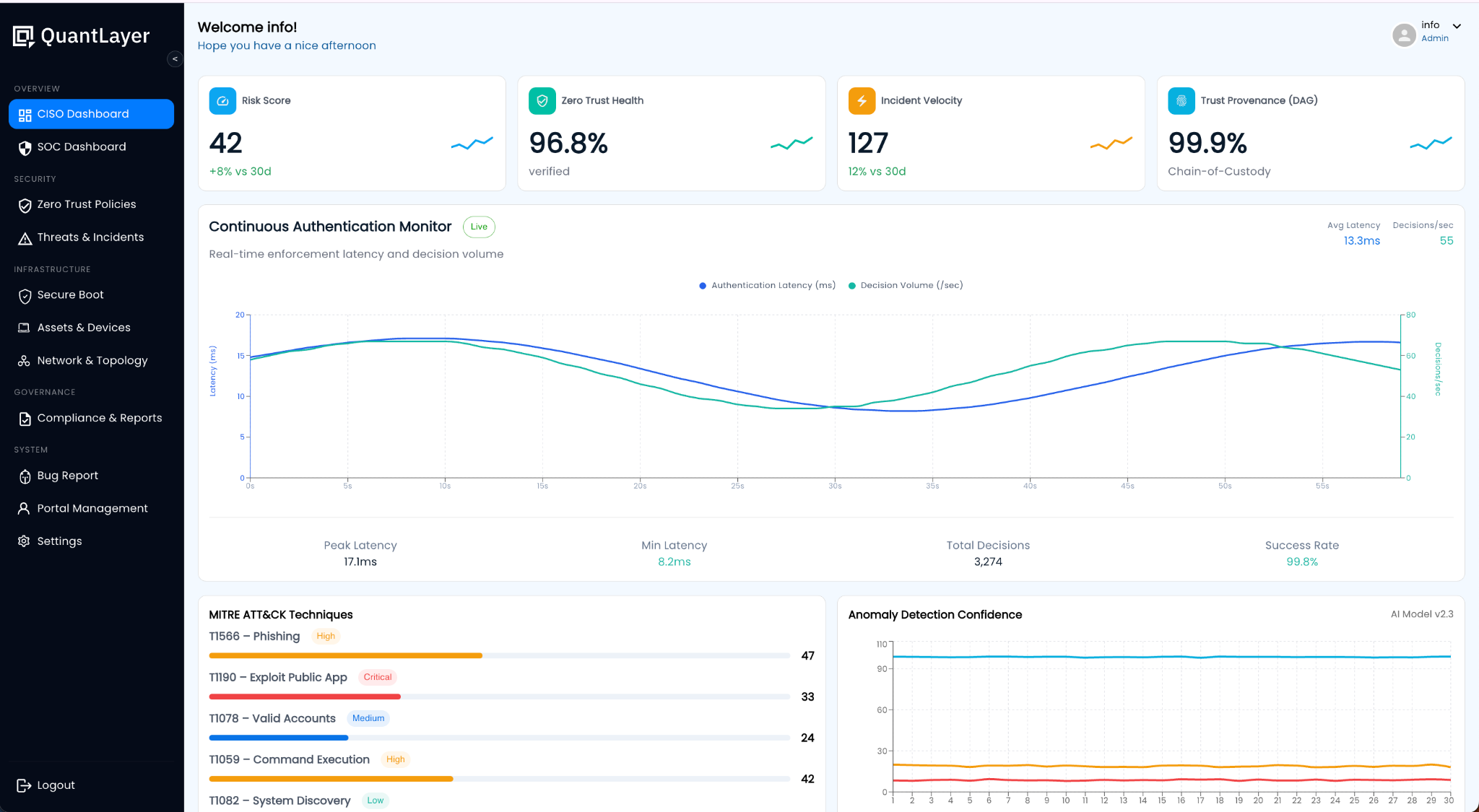
A guided tour of QuantLayer’s executive security view-risk, Zero Trust posture, OT resilience, compliance progress, and immutable evidence in one place.
What you get from the CISO Dashboard
The CISO Dashboard is designed for decision-making. It summarizes enterprise and OT risk signals, ties them to concrete controls, and turns telemetry into prioritized actions you can assign and track.
Primary outcome
Fewer high‑impact events
Secondary outcome
Faster containment
Proof outcome
Audit‑ready evidence
Sections inside this dashboard
- Risk Score - consolidated risk across vulnerabilities, anomalies, and asset criticality.
- Zero Trust Health - identity + device posture + segmentation policy health.
- Incident Velocity - how quickly threats are appearing and how fast you’re resolving them.
- Trust Provenance (DAG) - chain‑of‑custody and integrity assurance for events and decisions.
- Continuous Authentication Monitor - enforcement latency + decision volume (live).
- MITRE ATT&CK Techniques - top mapped techniques observed/blocked.
- Anomaly Detection Confidence - model confidence, drift, and false‑positive tuning.
- Asset Risk Heatmap - risk distribution across crown‑jewel assets.
- Threat Exposure Analysis - detection gaps + AI coverage and contextualization.
- Compliance Framework Progress - ISO/NIST/IEC alignment, control completion, gaps.
- Immutable Audit Log - blockchain‑anchored evidence trail and validation status.
- Policy Deviation Trend - drift over time and where controls are failing.
- OT Protocol Anomalies - suspicious protocol behaviors and lateral movement signals.
- Micro‑Segmentation Health - zone health and segmentation status.
- Prevention Success Rate - auto‑containment effectiveness + response time.
- Critical OT Assets - prioritized assets with last enforcement action and status.
- Blockchain Integrity - validator health, anchoring SLAs, replication integrity.
- Zero Trust Posture & Compliance Factors - posture trend and user/device factors.
How executives typically use it
- 1Start with Risk Scoreto understand overall exposure and what is driving it (vulns, anomalies, or critical assets).
- 2Validate Zero Trust Healthto confirm identity and device posture controls are holding.
- 3Review OT sections(protocol anomalies, micro-segmentation, critical assets) to manage operational risk.
- 4Export evidencefor audits, insurers, customers, or regulators-immutably anchored with chain-of-custody.
Why this matters to a CISO
AI only works if it’s trustworthy
If models drift or confidence drops, you’re flying blind. This keeps the AI layer honest.
Drift is normal in OT
New firmware, new shifts, new processes-all cause drift. You need to detect it early before it erodes detection quality.
Confidence drives automation
You can’t let AI auto-contain based on shaky confidence. This metric ensures automation stays aligned with risk appetite.
Feedback loops improve accuracy
Every analyst decision sharpens the models. This closes the loop between human intelligence and machine learning.
Reference UI Screenshot