CISO • ZERO TRUST
Zero Trust Health
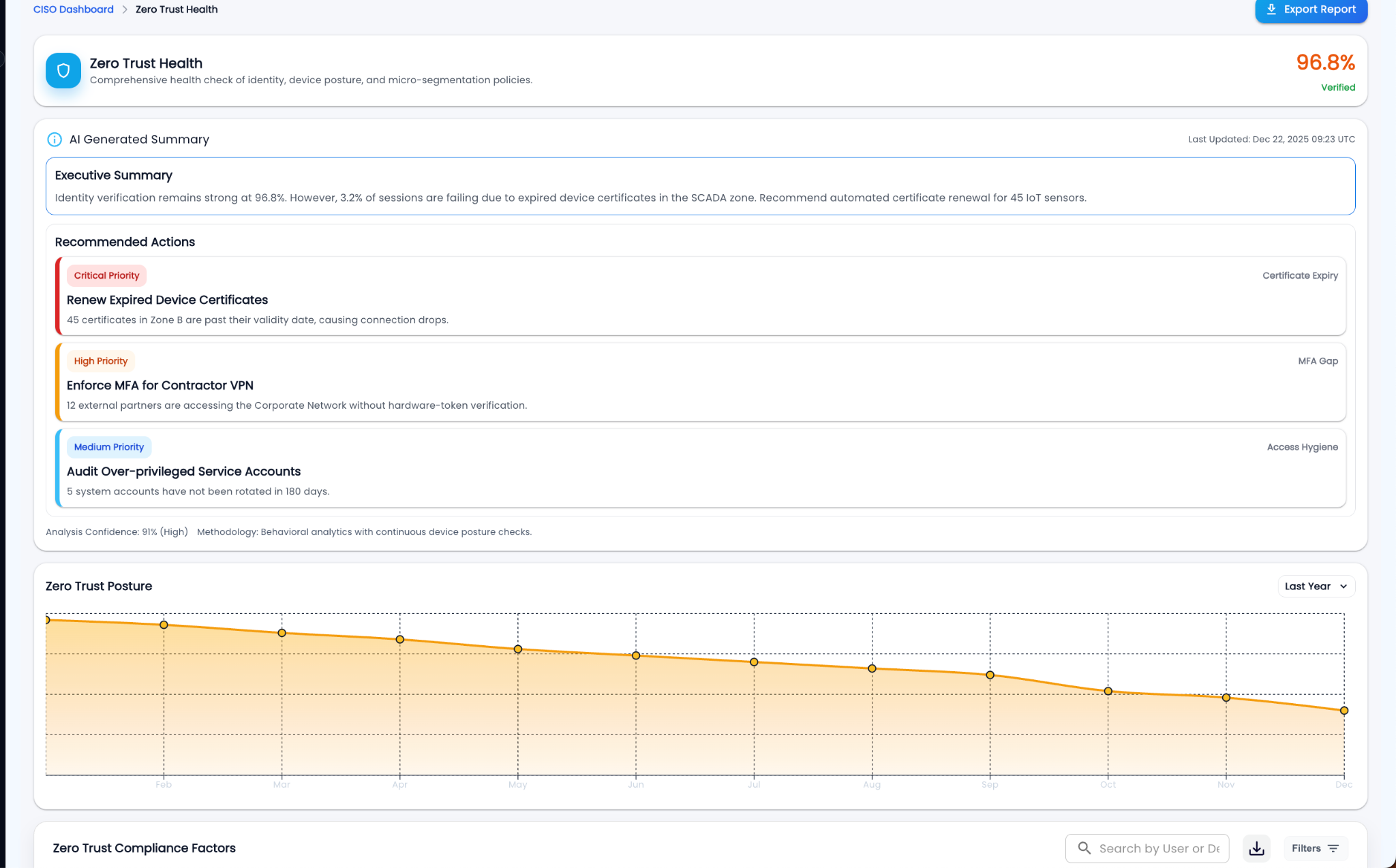
A health check across identity verification, device posture, and segmentation policy enforcement-measured continuously.
What it shows
This view answers: “Are we actually operating as Zero Trust today?” It surfaces verification failures, posture drift, and segmentation gaps before they become incidents.
How it’s calculated
- Identity verification success (passwordless/MFA, hardware-bound identity, session assurance).
- Device posture signals (secure boot, OS baseline, certificate validity, key lifecycle).
- Policy enforcement coverage (least privilege, micro-segmentation, conditional access rules).
- Exception handling (temporary waivers are tracked and time-bounded).
What to do next
- 1Fix the biggest failing category first(e.g., expired certificates in a SCADA zone).
- 2Close MFA gapsfor contractors and privileged accounts; remove “shadow admin” access.
- 3Review over-privileged service accountsand rotate secrets/keys on schedule.
- 4Automate renewals(certs/keys) and enforce “deny by default” for unmanaged devices.
KPIs to watch
Health %
Verified
Failing sessions
count
Top gap
MFA / cert / policy
Why this matters to a CISO
AI only works if it’s trustworthy
If models drift or confidence drops, you’re flying blind. This keeps the AI layer honest.
Drift is normal in OT
New firmware, new shifts, new processes-all cause drift. You need to detect it early before it erodes detection quality.
Confidence drives automation
You can’t let AI auto-contain based on shaky confidence. This metric ensures automation stays aligned with risk appetite.
Feedback loops improve accuracy
Every analyst decision sharpens the models. This closes the loop between human intelligence and machine learning.
Reference UI Screenshot